Teaching special parallelograms can feel deceptively simple—until students start mixing up the properties of rectangles, rhombuses, and squares. One day they can identify each shape just fine, and the next day they’re convinced a rectangle can’t be a parallelogram or that a rhombus must have four right angles. 😅
The truth is, this topic requires more than a single worksheet or lecture. Students need multiple exposures, different formats, and opportunities to apply properties—not just memorize them. When instruction feels repetitive or abstract, engagement drops fast, and misconceptions stick around longer than we’d like.
That’s where variety comes in. By using a mix of guided notes, structured practice, and interactive activities, you can help students build a clear understanding of how special parallelograms are related—and why their properties matter.
In this post, I’m sharing 4 fun and effective activities you can use to teach special parallelograms in your geometry class. These ideas work for introducing concepts, reinforcing skills, reviewing before assessments, and even keeping early finishers engaged—without adding extra prep to your plate.
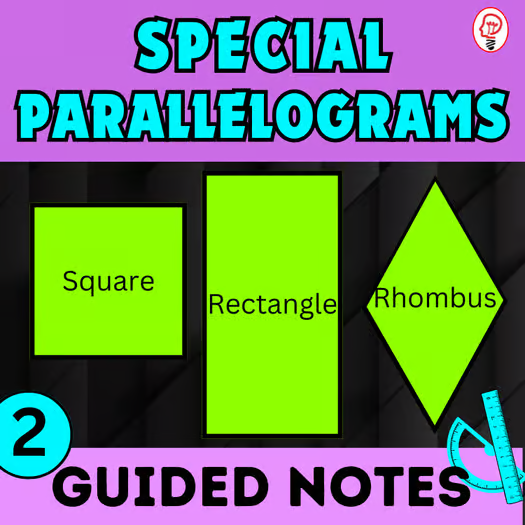
Activity #1: Guided Notes to Introduce Special Parallelograms
When students are first learning about rectangles, rhombuses, and squares, guided notes are a game changer.
Instead of frantically copying definitions and properties from the board, guided notes allow students to:
- Focus on key ideas
- See how each shape connects to a parallelogram
- Organize information in a way that actually makes sense
This is especially helpful when you’re emphasizing similarities and differences, like:
- All squares are rectangles and rhombuses
- Not all rectangles are squares
- Diagonals behave differently depending on the shape
How to use guided notes in class:
- As a whole-group lesson with pauses for discussion
- In interactive notebooks
- Digitally or printed, depending on your setup
💡 Teaching tip: After each shape, have students highlight or annotate properties that overlap with other special parallelograms. This helps prevent confusion later.
Why teachers love it:
Less copying, more thinking—and a stronger foundation before students move into practice.
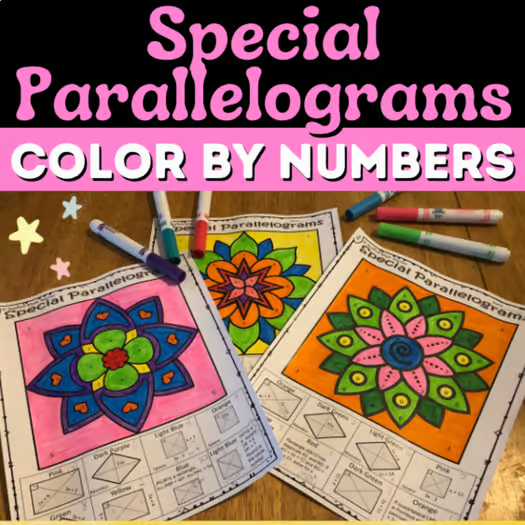
Activity #2: Color-by-Number for Engagement & Confidence
Yes—color-by-number works in geometry, even at the middle and high school level.
Color-by-number activities give students a low-pressure way to review while still reinforcing important concepts. Because students must answer correctly to reveal the picture, they stay focused and motivated.
These activities are especially helpful for:
- Students who need confidence boosts
- Visual learners
- Days when attention spans are low
Best times to use color-by-number activities:
- Early finisher work
- Review days
- Sub plans
- Low-stress practice before a quiz
And as a bonus? Your classroom stays quietly productive.
Why teachers love it:
High engagement with almost no prep—and students don’t even realize how much they’re practicing.
Activity #3: Maze Worksheets for Review & Assessment
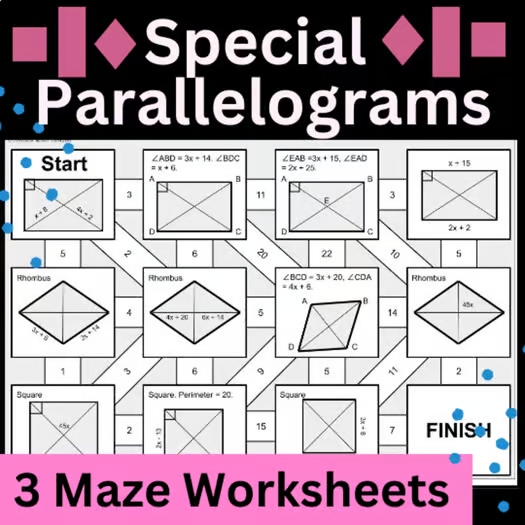
Maze activities are one of the best ways to turn review into something students actually enjoy.
To move through the maze, students must answer each question correctly. One wrong answer sends them down the wrong path—making misconceptions immediately obvious.
Maze worksheets are great for:
- Formative assessment
- Review before a quiz or test
- Math stations or rotations
- Exit tickets
They also encourage students to self-correct, which leads to deeper understanding.
Why teachers love it:
You can quickly see who understands special parallelograms—and who needs reteaching—without a traditional quiz.
How to Use All 4 Activities Together
If you want a simple lesson flow, here’s one option:
- Day 1: Guided notes to introduce special parallelograms
- Day 2: Practice worksheets for skill mastery
- Day 3: Color-by-number or maze for reinforcement
- Day 4: Stations using all activities or final review
This structure works well in 45–60 minute class periods and keeps students engaged throughout the unit.
Why This Variety Helps Students Master Special Parallelograms
Using multiple activity types allows students to:
- See concepts presented in different ways
- Practice without boredom
- Engage visually, logically, and independently
Most importantly, it helps students understand that special parallelograms are connected, not isolated topics they have to memorize.
Activity #4: Practice Worksheets for Skill Mastery
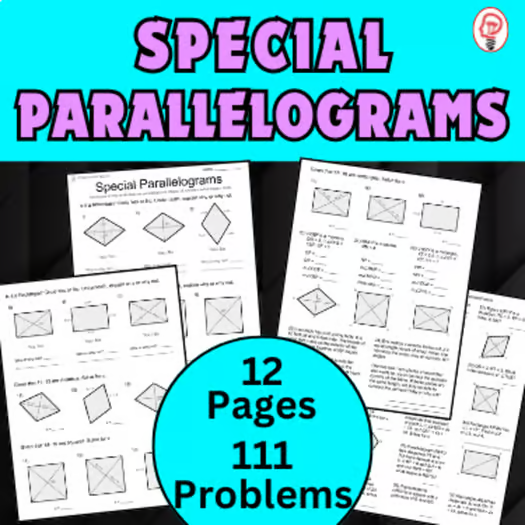
Once students understand the properties, they need repetition with purpose.
Practice worksheets give students the chance to:
- Identify properties of special parallelograms
- Classify shapes based on given information
- Apply definitions rather than memorize them
These are perfect for solidifying understanding and catching misconceptions early.
Ways to use practice worksheets:
- Independent classwork
- Homework
- Small-group or reteach lessons
Easy differentiation ideas:
- Assign only rectangle problems to students who need targeted practice
- Use rhombus and square problems as a challenge set
- Pull questions for quick checks or warm-ups
Why teachers love it:
Straightforward, standards-aligned practice that’s easy to implement and easy to assess.
Save Time With Ready-to-Use Geometry Activities
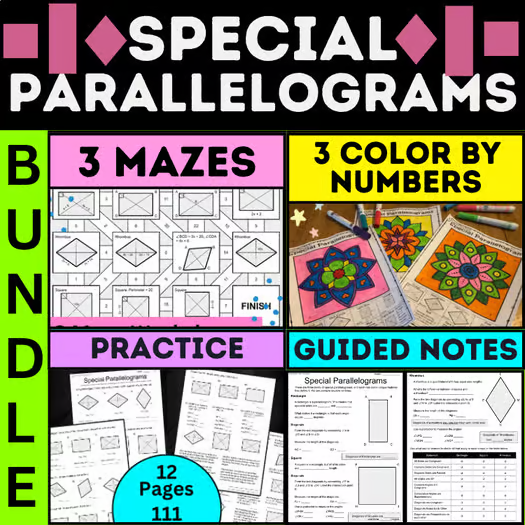
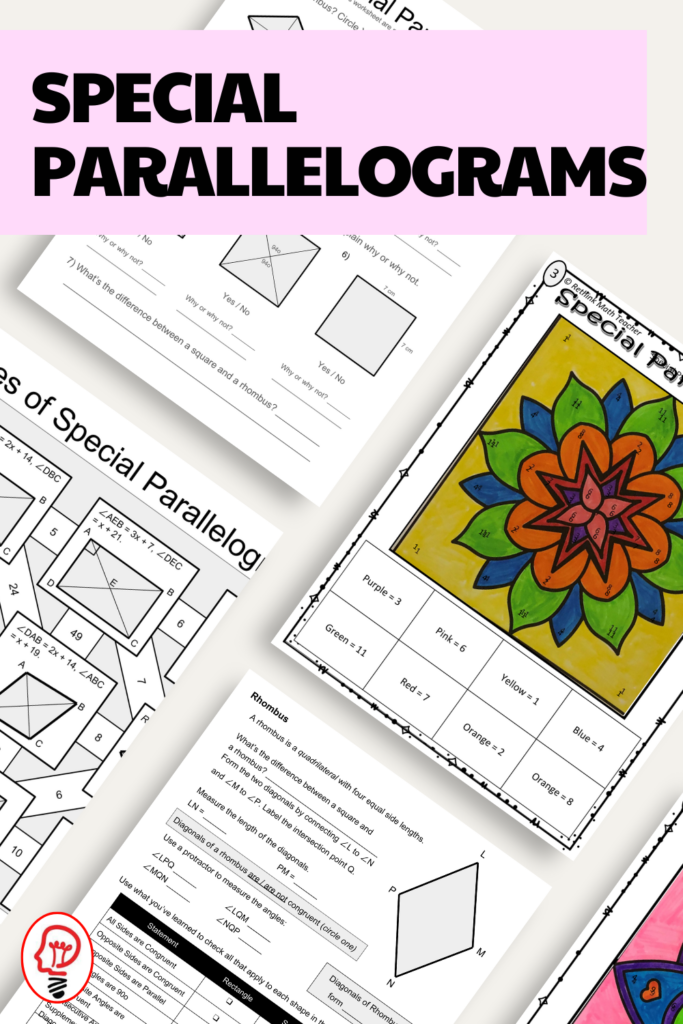
If you’re looking for a done-for-you option that includes guided notes, practice worksheets, color-by-number activities, and mazes, the Special Parallelograms Bundle makes planning this unit simple.
Everything is designed to work together—so you can spend less time prepping and more time helping students succeed.
Check out my Special Parallelograms Bundle